B.12 Dänkritz 1 Uranium Remediation Case Study
Sachsen, Germany
Acknowledgments
The mining team would like to acknowledge H. Eric Nuttall, ITRC member who submitted the Biochemical Reactors Case Study. The information in this case study is for the Biochemical Reactors used to Treat Mine Influenced Water prepared by the ITRC Mining Team 2013.
B.12.1 Site Information
During the Cold War, uranium mining, milling, and related processing activities were conducted with little care for the environment. Large quantities of liquid and solid radioactive and hazardous wastes were deposited in unlined surface sites. In many cases, these wastes have contaminated the soil and the ground-water, and contaminants have migrated away from the site.
This pilot study focuses on the long-term stability of uraninite (UO₂) in the underground at a large tailings pond, ‘Dänkritz 1’ in Germany. The research studies for this pilot plant investigation were initially conducted at the University of New Mexico in Albuquerque, New Mexico and then followed up with large bench scale multiple year experiments in Germany.
Hence there are numerous potential sites in this mining region of Germany where BCR technology could potentially be successfully applied.
Contacts
Dr. Eric Nuttall
1445 Honeysuckle Dr. NE
Albuquerque, NM 87122
Dr. Werner Lutze
Director of the Nuclear Environmental Protection Program
The Catholic University of America
620 Michigan Ave., N.E. Washington, DC 20064
Name, Location, and Site Description
Dänkritz 1, Sachsen, Germany
This pilot study focuses on the long-term stability of uraninite (UO₂) in the underground at a large tailings pond.
B.12.2 MIW Chemistry
Many radionuclides and metals ions can be converted from soluble to minerals by changing the valence of the metal ion. In the case of uranium the higher +6 valence is soluble in groundwater and migrates to form contaminated plumes and problems with drinking water. The current USEPA MCLmaximum contaminant level for uranium in drinking water is 30 ppb. Many laboratory studies have shown that soluble uranium (+6) can be biologically transformed to insoluble uranium (+4), the mineral uraninite.
The chemistry used specifically in this case study to remove uranium by mineral precipitation is to anaerobically treat the groundwater using an appropriate carbon substrateEither (a) a chemical which reacts or (b) a solid surface or (c) an electron donor.. Substrates can be either liquid or solid carbon sources. The key to this specific approach is to biologically reduce the uranium to U+4 (the mineral uraninite) and then keep it in a reducedIn chemistry, having gained electrons. Often gaining electrons is accompanied with gaining protons (hydrogen). As an example, when O₂ reacts with H₂, the oxygen is reduced, forming H₂O. state by also forming iron sulfide which functions as a very effective oxygen getter thereby preventing the uraninite from reoxidizing to soluble U+6. Key reactions are shown below.
Oxyen and nitrate removal—if present:
2O= +
Reduction of Metals and Sulfate:

Uranium Reduction to insoluble uraninite mineral:

B.12.3 BCR Design
B.12.3.1 Bench Scale Test
The testing consists of long-term bench scale experiment followed by a pilot scale field investigation. A single-pass flow-through experiment was run in a 100-liter column: bioremediation for 1 year followed by infiltration of tap water (2.5 years) saturated with oxygen, sufficient to oxidize the precipitated uraninite in two months. Instead, only 1 wt.% uraninite was released over 2.4 years at concentrations typically less than 20 μg/L. Uraninite was protected against oxidation by the mineral mackinawite (FeS), a considerable amount of which had formed, together with uraninite. Figure B.12-1 is an EhThe redox potential is the tendency of a compound to gain an electron. This is most often measured as the voltage required to prevent electrons to transfer between the measured sample and a standard reference electrode. For Eh, that standard reference, defined as zero volts, is H2 → 2 H+ + 2 e- at a specified standard condition.-pH diagram illustrating that iron sulfide precipitates at a lower Eh than does uraninite, preventing the uraninite from re-oxidizing the uranium from U+4 to soluble U+6.
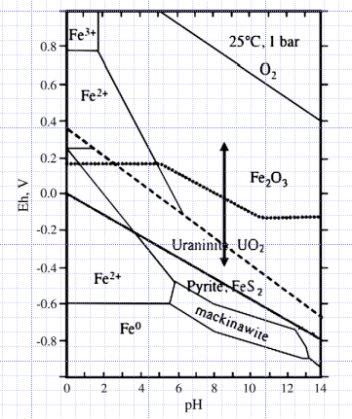
Figure B.12-1. Partial Eh-pH diagram Fe-U-S-O.
The bench scale system, which was operated successfully for 3.5 yrs is a 55 gal drum scale column as illustrated in Figure. B.12-2.
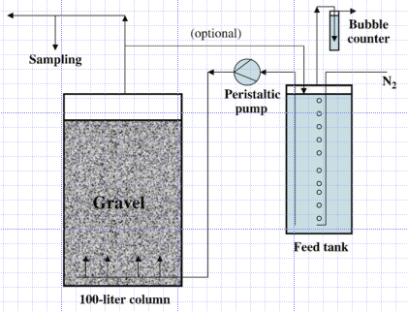
Figure B.12-2. Schematic of the column experiment.
B.12.3.2 Field Pilot Test
A confined field test was conducted adjacent to the tailings pond, which after bio-stimulation showed similarly encouraging results as in the laboratory. Taking Dänkritz 1 as an example we show that in situ bioremediation can be available option for long-term site remediation, if the process is designed based on sufficient laboratory and field data. The pilot test system is illustrated in Figure B.12-3.
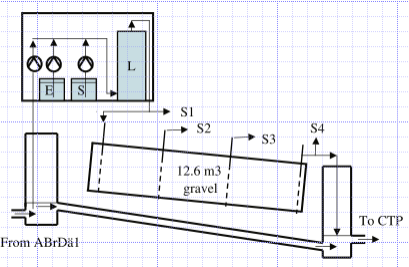
Figure B.12-3. Schematic representation of the confined field test. S1 to S4 = sample ports; E &S = reservoirs for ethanol, STMP, respectively, L = pre-reactor; CTP = Chemical treatment plant.
B.12.4 BCR Performance
The results of the confined field experiment (Figure B.12-4) can be interpreted by assuming that biotic reduction of uranium, iron, and sulfate is taking place and that uraninite and iron sulfide (mackinawite) precipitate on the gravel. These processes are relatively fast and effective. It is most likely a matter of optimizing the amount of amendment and potentially of additional amendments in individual chambers of the column to further lower the uranium concentration to a desirable level. Based on our results for uraninite stability, we conclude this discussion with a speculation about the effectiveness of in situ bioremediation and the stability of uraninite in the underground after termination of a respective process at Dänkritz 1.
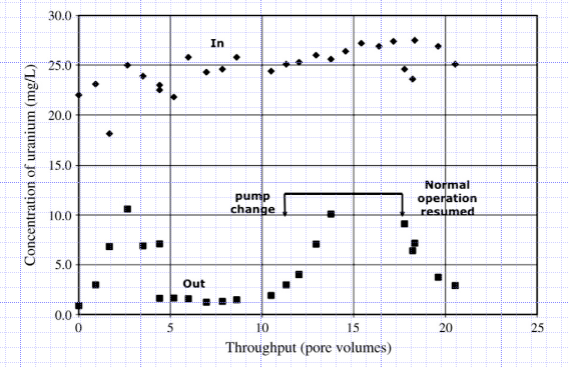
Figure B.12-4. Input and output concentration of uranium (pilot test)
B.12.5 Conclusions
Laboratory and field tests provided evidence that uranium in contaminated groundwater can be reduced, precipitated and accumulated as uraninite (UO₂) on soil surfaces by in situ bioremediation. Fe(III) in minerals such as goethite and hematite in the host rock is reduced biotically to Fe(II) and sulfate to sulfide. As a result, iron sulfide precipitates, e.g. as mackinawite (FeS 0.9). Iron sulfide acts as a redox buffer protecting uraninite from oxidation by in filtration of dissolved oxygen. The sulfide is less stable thermodynamically and is oxidized to sulfate. An atomic ratio S:U=18:1 was large enough to protect uraninite for 2.4 years in the presence of oxygen-saturated tap water. Only 1% of the deposited uraninite was released during this time and the uranium concentration was <35 μg/L. The results of this study support our hypothesis that uraninite can be stabilized by mackinawite and that an in situ bioremediation process can be developed based on this finding.
B.12.6 Regulatory and Stakeholder Challenges
This bioremediation process was strongly supported by the regulators and stakeholders because it was viewed as a natural biological system and, being on-site, did not produce secondary waste. These supporters felt this option was superior to pump and treat or to hydrological control of recharge water to the tailing piles. However, the system is a pilot scale test and is presently only applicable to small seepages from the tailing piles. Therefore, bioremediation is only one of perhaps several remedial options.
B.12.7 Other Challenges and Lessons Learned
The pilot field test showed that changes in groundwater chemistry can negatively affect the bacteria’s ability to directly reduce uranium+6to uranium+4 and thus remediate the groundwater.
B.12.8 References
Abdelouas A, L.Y. Lutze W Nuttall H.E. 1998. Reduction of U(VI) to U9IV) by indigenous bacteria in Contamianted Groundwater. J. Contam. Hydrol. 1998 a 35:217 – 33
Abdelouas A, Lutze W. NuttallH.E., 1998. Chemcial Reactiosn of Uranium In Groundwater at a Mill Tailings Sites. J Cont. Hydrol. 1998b 34:343-61
Abdelouas A, Lutxze W, Nuttall H.E., 1999. Oxidateve Dissolution of Uraninite mprecipitated on Navajo Sandstone. J Contam. Hydrol. 1999a 36:353-75
Abdelouas A, LutZe W., Nuttal H/E., 1999. Uranium Contamination in the Subsurface: Characterization and Remediation in: Burns PC, Finch R. Editors. Uranium Mineralogy Geochemistry and the Environment, Vol 38. Reviews In Mineralogy 1999b. P 433-73.
Abdelouas A. DengI, Nuttall H.E. Lutze W. Fritz Crovisier II. 1999. In Situ Biological denitrification of Groundwater. C.R. Acad. Sci 1999c 328-:161-6.
Abdelouas A. LutzeW. Cong W. Nuttal; H.E. Streitelmeir BA, Travis B.J. 2000. Bioogical Reduction of Uranium in Groundwater and Subsurface Soil. 250:2000. P 21-35.
Anderson R.T. Vrionis H.A. Ortiz-Bernad I. Resch C.T. Long P.E. Dayvault R. et al. Stimulating the In Situ Activity of Geobacter Species to Remove Uranium from the Groundwater of the Uranium-contaminated Aquifer. Appl. Amd Environ. Microbiol 2003: 5884-91
Beleites M. Altlast Wismut. Ausnahmezustand, 1992. Umseltkatastrophjic und Das Snier-ungsproblem im deutschen Uranbergbau, Brandes and Apsel Verlag, Frankfurt/Main3-86099-104-3:m 1992.
Blanc P.L. 1995.Aquirements of ;the Natural Analogy Program. Oklo Natural Analogue for a radioactive waste repository. Final Report ISPN/. France: Fontenay-aux-Roses. 1995
Brooklins D.G. eh-pH Diagrams for Geochemicstry. New York: Springer Verlag. 1988.
DOE UMTRA Surface Project Management Action Process Document: Technical Report DOE/AL/62350-221-Rev-2: 1996
Dong W. Brooks S.C. Determination of the Formation Constants of Ternary Complexes of Uranyl and Carbonate with Alkaline Earth Metals (Mg2+,Ca2+, Sr2+, and Ba2+)
Druhan J.L. et al., Sulfir Isotopes as indicators of amended VBacterial Sulfate Reduction processes Influencing Field Scale Uranium Bioremediation. Environ. Sci. Tech. 2008:42:78452-9
Janaczek J. Mineralogy and Geochemicstry of Natrual Fission Reactors in Gabon. In: Burns P.C. Finch R. Editors. Uranium Mineralogy, Geochemicstry and the Environment, Vol. 38. Revierws in Mineralogy: 1999 p 312-92.
Publication Date: November 2013