Enzymes are typically proteins and they are responsible for catalyzing all of the biochemical reactions brought about by microorganisms. Enzyme-catalyzed reactions all convert one or more starting compounds (substrates) into one or more products. However, enzymesAny of numerous proteins or conjugated proteins produced by living organisms and facilitating biochemical reactions (based on USEPA 2004a). are rarely absolutely specific and they can often transform compounds other than their physiologically relevant substrateAny substance that is acted upon by an enzyme.. The enzyme activity probes (EAPs)Transformation of surrogate compounds (probes) resembling contaminants produces a fluorescent (or other distinct) signal in cells which is then detected using a microscope. capitalize on this lack of enzyme specificity and act as alternative or surrogate substrates for specific enzymes involved in contaminant degradation processes. EAPs are useful because they can be added to environmental samples, where they are transformed by their target enzymes into distinct and readily detectable products. These products can be detected through fluormetric, colormetric or analytical methods, which determine if there is a positive response. Most contaminant-degrading enzymes are only active in intact microbial cells, so a positive response to an EAP can indicate the presence of microorganisms that possess active forms of the target enzyme. A positive response also suggests that contaminant biodegradationA process by which microorganisms transform or alter (through metabolic or enzymatic action) the structure of chemicals introduced into the environment (USEPA 2011). is therefore possible at the site and may even indicate biodegradation is ongoing.
An important distinction in EAPs is that the EAPs themselves are not catalyzing reactions (the target enzymes do that), EAPs are chemicals that are transformed by the target enzymes (which catalyze the reactions) and generate specific products that are assessed through fluorometric, colormetric, or analytical methods. Another question might be are EAPs transformed by non-target enzymes to generate the same products? For the EAPs discussed herein, there is no evidence that non–target enzymes will transform the substrate(s) into the same detectable products.
EAPs rely on the metabolic activityRefers to when a microorganism performs a specific function (e.g., sulfate reduction, metabolism of benzene) of single cells present in the subsurface. As such, any geochemical or environmental condition that could impact the overall physiological status or activity of cells could directly impact EAPs and include metrics as pH, temperature, and redox conditionsDescription of the oxidation/reduction potential of the subsurface (e.g. aerobic, anaerobic, sulfate reducing, or methanogenic conditions). In particular, metals and other chemicals if present at high enough concentrations, have the potential to inhibit the metabolic activity, and the detection of activity with EAP, of target cells. The concentration of organic matter does not seem to impact the detection of activity with EAPs. For example, at several contaminated sites where the concentration of organic matter is below quantifiable amounts (for instance, large oligotrophic plumes), EAPs will detect active oxygenaseAn enzyme that catalyzes the incorporation of molecular oxygen into a compound (based on Madigan et al. 2010). enzymes. Most EAP inhibitors are other chemicals that should not be found at high enough concentrations in groundwater (such as acetylene and 1-pentyne). In cases where multiple contaminants are co-mingled, those contaminants which provide the cells with carbon and energy for growth will likely out-compete the EAPs but will not inhibit them. In general auto fluorescence and other background fluorescence which occurs naturally in groundwater, surface water and in soils and sediments can be problematic with some EAPs.
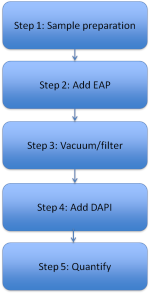
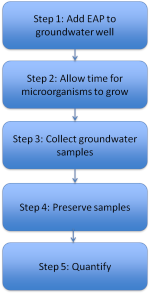
Additional introductory information is available in the EAP Fact Sheet. Figure 8-1 illustrates the analytical process for EAPs.
Microbiologists used various forms of EAPs for decades prior to applying these methods to detecting contaminant-degrading microorganisms. For example, the acetylene reduction assay (a longstanding EAP) can quantify aspects of the nitrogen cycle (Dilworth et al. 1966; Hardy et al. 1968, 1973; Stewart et al. 1967). Some bacteria can reduce atmospheric nitrogen gas (N2) into ammonia (NH3), which is then used as a nitrogen source to support growth (Bergersen 1970). This process is of central importance to the biological nitrogen cycle. The activity of nitrogenase, the key enzyme responsible for this activity, can be determined by its ability to reduce acetylene (C2H2) to ethylene (C2H4) by gas chromatography. This quantitative analysis has been used in numerous studies of the environmental distribution of nitrogen-fixing microorganisms (Hardy et al. 1968, 1973; Howarth et al. 1988).
Over the last thirty years, several EAPs have been developed for enzymes involved in anaerobic and aerobic contaminant biodegradation processes. These EAPs have subsequently been used to evaluate biodegradation at sites with contaminants including chlorinated solvents and petroleum hydrocarbons. Table 1 in the EAP Fact Sheet lists several currently recognized EAPs for various oxygenase and dehalogenaseAn enzyme that catalyzes the removal of a halogen atom from an organic compound. enzymes involved in specific biodegradation processes. Note that EAPs are enzyme specific rather than contaminant specific. For instance, coumarin is an EAP used to detect the activity of soluble methane monoooxygenase (sMMO) found in methane-oxidizing (methanotrophic) bacteria. sMMO can oxidize a wide range of pollutants including chlorinated solvents such as TCE and ethers such as 1,4-dioxane. The same contaminants can also be oxidized by some of the several forms of toluene monooxygenase found in aerobic toluene-oxidizing bacteria. These enzymes are detected using a different type of EAP (such as phenylacetylene) even though the contaminants degraded by these enzymes can be the same as those degraded by sMMO.
Examples of diverse applications of EAPs are provided in Table 8-1. A brief explanation of several key studies and their findings follows the table.
|
Title |
General information |
Contaminants |
EMDs |
Project life cycle stage |
|---|---|---|---|---|
|
Test Area North, Idaho National Laboratory, ID (see summary below) |
Evaluated aerobic co-metabolism targeting aerobic oxygenases using the following EAPs: coumarin, hydroxyphenylacetylene, 3-hydroxy-phenylacetylene |
TCE |
EAP, CSIA, PCR, qPCR |
Remediation |
|
Chemical Manufacturing Plant, CA (see summary below) |
Evaluated anaerobic metabolism targeting TCE reductase using the TCFE EAP |
TCE |
EAP, PCR, SIP |
Site Characterization |
|
Former Cement Company, NY(see summary below) |
Evaluated aerobic co-metabolism targeting aerobic oxygenases using the following EAPs: coumarin; naphthalene, hydroxyphenylacetylene, 3-hydroxy-phenylacetylene; trans-cinnamonitrile |
1,1,1-TCA; TCE |
EAP, PCR, qPCR |
Site Characterization, Remediation |
|
SIP Case Study - AFP 44, AZ (see Appendix A.8) |
Evaluated aerobic co-metabolism targeting aerobic oxygenases with the following EAPs: coumarin, hydroxyphenylacetylene,3-hydroxy-phenylacetylene |
TCE |
SIP, qPCR, EAP |
Site Characterization, Remediation |
|
EAP Case Study - Paducah Gaseous Diffusion Plant, KY (see Appendix A.7) |
Evaluated aerobic co-metabolism targeting aerobic oxygenases using the following EAPs: coumarin, hydroxyphenylacetylene, 3-hydroxy-phenylacetylene, trans-cinnamonitrile |
TCE |
EAP, CSIA, qPCR |
Site Characterization, Remediation |
This research project was conducted at the TCE-contaminated Test Area North (TAN) site at the Idaho National Laboratory. EAPs and other EMDs (see Section 9.2) were used to investigate the co-metabolic oxidation and natural attenuation of TCE by methane-oxidizing bacteria using coumarin as an EAP to detect sMMO activity (Wymore et al. 2007) and by aromatic-degrading bacteria using phenylacetylene and 3-hydroxy-phenylacetylene (M. H. Lee et al. 2008). Groundwater samples were obtained from various depths. Aerobic oxidation analyses were conducted with a suite of EAPs, either directly on groundwater or using or cells concentrated by filtration.
For the coumarin analysis, the generation of fluorescent coumarin-derived oxidation products (such as 7-hydroxycoumarin) was determined using a fluorescence spectrophotometer (data recorded as relative fluorescence units, RFU, over background values). For the aromatic oxygenases analyses, the number of cells, active enzymes, that transformed the EAP into quantifiable fluorescent products was determined by microscopy (data recorded as cells by volume or weight). Fluorescent product generation was widespread among the samples examined and was typically decreased by selective inhibitors. The presence of active enzymes was confirmed using other EAPs, enrichment cultures of bacteria with oxygenases enzymes, and PCR-based analyses for distinctive genes involved in aerobic bacterial oxidation. Collectively the results of these various analyses support the suggestion that both methane- and aromatic-oxidizing bacteria are present and active in the groundwater at the TAN site and are contributing to the natural attenuation of TCE at this site.
Trichlorofluoroethylene (TCFE) is an EAP that can be used to determine the activities of PCE- and TCE-reducing microorganisms. This particular EAP is useful because the fluorine atom is not removed during reductive dehalogenation of this compound. In this study, TCFE was used to determine rates of chlorinated solvent reduction (PCE and TCE) at a former chemical manufacturing plant. A push-pull test system was used to introduce TCFE into groundwater. Samples were recovered over time (≤3 months) and were analyzed by GC/MS. Fluorinated reduction products were generated from TCFE in TCE-contaminated portions of the site but not in uncontaminated areas. The results demonstrated that TCFE biodegradation occurred at comparable rates to TCE. Furthermore, TCFE was also shown to have similar in situ transport properties to TCE (Hageman et al. 2001).
Aerobic oxygenase EAPs were applied to soil cores from a former cement factory in upstate New York. Historical contaminants at the site included 1,1,1-TCA, petroleum hydrocarbons, and chlorinated solvents. Carbon in the form of methane and the petroleum hydrocarbon contaminants were present across the site and suspected to be stimulating the aerobic oxygenases in situ. EAPs were applied to six soil cores from within and outside the contaminated area and sampled for at least two depths, specifically above the mapped contaminated zone. The methods for analyzing the samples were similar to the example above, except cells were first washed from the solid materials prior to exposure to the EAPs. Fluorescence was recorded in all of the samples, either in solution (RFUs) for the methane monooxygenase or enumerated by microscopy (active cells per g of soil) for aromatic oxygenases.
The presence of active enzymes was confirmed by inhibition analyses and qPCR amplification of target enzymes. Inhibition analyses were conducted to verify that EAP products formed were from reactions with sMMO and not other oxygenase activity. Assays using phenylacetylene and methane were conducted as described in Wymore et al. 2007. The methane study is particularly important because it is a reversible inhibitor; once the enzyme is saturated with methane, it will not be able to transform the EAP, however when the methane is removed, the cells react equally with the EAP and methane and a fluorescent product is measured. Collectively the results suggested that aerobic oxidizing bacteria were present and active in the soils at the site and likely involved in the attenuation of the contaminants, thus minimizing vapor intrusion issues at the location.
The application, analysis, and interpretation of microbiology-based EMD methods differ from typical soil and groundwater geochemical measurement in a number of ways. For example, microbial biomarkers cannot easily be preserved, and sample handling and processing requires special care. The analysis of microbial parameters requires specific data quality considerations for sampling plans, sample collection and handling, quality control and laboratory procedures, and these are discussed in Section 10. Included below is a brief introduction to how EAP data are typically reported and some specific examples of how the data would be interpreted in answering the questions presented in Table 2-3.
The range of EAPs that have been developed to date is focused mainly on enzymes involved in aerobic oxidation of contaminants and reductive dehalogenation of chlorinated ethenes. Currently no EAPs exist for investigating metal-transforming microbial processes or microbial process directed at explosives, PCBs, or flame retardants. EAPs would not be appropriate for determining the presence of organisms capable of transforming these types of contaminants. Information for EAP data quality is included in Section 10.
EAPs used in laboratory analyses are often fluorescent. In some EAP applications, cells that transform an EAP internally accumulate fluorescent products and can then be enumerated by epifluorescent microscopy. The number of fluorescent cells is then compared to the total number of cells stained with a universal DNA-reactive stain such as acridine orange (AO) or DAPI (4.6-diamindino-phenylindole). These types of EAP results are typically presented as either relative fluorescence units (RFU) or the number of target cells (fluorescent cells) per volume of groundwater or per weight of soil. Results can also be presented as the fraction of the total cells that are active (active cells/total cells) and recorded as the percent of total. In other cases, the fluorescent products are detected in the reaction medium and can be used to determine relative rates of EAP transformation. These results can then be correlated with other independent approaches for determining cell numbers or the abundance of the genes that encode the target enzyme in the sample. Field applications of EAPs that target contaminant-degrading enzymes are relatively limited and have focused on chlorinated solvents such as TCE. In these studies, the rate of reduction of compounds such as TCFE can be stated and compared to site-specific rates of TCE reduction.
Included in Table 8.2 below is information that should be provided in laboratory reports of EAP data including common laboratory report information, recommended information about the EAP method, and desirable information about the EAP method and results.
Additional information regarding sample handling and collection can be found in Section 10, the data quality section.
Laboratory EAP data are used most often to determine the presence and activity of organisms and/or enzymes and to demonstrate the possibility of current biodegradation of specific contaminants. These analyses can be useful for site characterization, remediation, and monitoring. The presence of active enzymes/microorganisms indicated by EAPs can then be used in combination with other conventional data and EMD data to provide a line of evidence for current or potential biodegradation activity at a site. Although less frequently deployed, EAP-based field studies using approaches such as push-pull tests can also provide direct estimates of contaminant biodegrading activities in contaminated groundwater environments. To illustrate interpretation of EAP results, the questions relevant to EAPs in Table 2.3 are discussed below.
A) Are contaminant-degrading microorganisms present?
The range of EAPs that have been developed to date is limited mainly to enzymes involved in (a) aerobic aromatic hydrocarbon oxidation, (b) aerobic methane oxidation and (c) reductive dehalogenation of chlorinated ethenes. If the contaminants at a site can be transformed by key enzymes that involve enzymes such as toluene-oxidizing oxygenases, methane monooxygenase or chlorinated ethene reductases then EAPs can be used to answer whether contaminant-degrading microorganisms are present. Laboratory-based EAP studies could be used to demonstrate the presence (or absence) of specific contaminant-degrading enzymes at a site. For instance, at a site contaminated by petroleum hydrocarbons or BTEX-containing LNAPLs, EAPs such as 3-hydroxyphenylacetylene could be used to detect and quantify toluene-oxidizing organisms and toluene-degrading activity in aerobic areas. Alternatively, coumarin could be used to detect sMMO activity in site samples contaminated by poorly characterized xenobiotics. This information could be useful if the purified sMMO enzyme system or sMMO-expressing bacteria had previously been shown to degrade the xenobiotic under investigation. Field-derived estimates of chlorinated ethene degradation rates could also be determined using push-pull tests using EAPs such as TCFE.
B) Are contaminant degrading microorganisms active?
EAPs are currently the most direct method for determining whether “active” microorganisms are present in samples from a site. EAPs are surrogate substrates specific for an enzyme, which when transformed into a detectable product, signifying that the degrading enzymes in the given sample are active at the time of analysis. However, incubation conditions used in laboratory-based studies may not always accurately reflect in situ conditions. For example, many of the current EAPs are for aerobic enzyme systems (Table 1, EAP Fact Sheet). The detection of an EAP-transforming activity in samples incubated in the presence of saturated oxygen concentrations in the laboratory may not accurately reflect in situ conditions; carefully plan both field sampling and laboratory analysis to ensure that accurate data are obtained. Many EAPs also interrogate co-metabolic biodegradation processes that rely on the presence of a growth supporting substrate to support microbial growth and activity of the EAP-target enzyme. For example, TCE is co-metabolically biodegraded by sMMO in bacteria that grow on methane under aerobic conditions. The laboratory detection of sMMO activity in a sample using an EAP such as coumarin may indicate the presence of sMMO in microorganisms in the site sample. However, the activity of these microorganisms and/or sMMO may be constrained in situ by ambient methane concentrations. Some of these ambiguities associated with the use of EAPs can be lessened if the EAP analyses are carefully and thoughtfully designed, and EAPs are used for in situ studies where the EAP exposure occurs under the prevailing environmental conditions at the site.
D) Is biodegradation occurring?
As indicated for Question B, EAPs can provide some of the most direct EMD-based evidence for ongoing biodegradation. Most EAPs determine the activity of degrading enzymes of interest; most analyses provide quantified information regarding the total number of organisms with active enzymes as a fraction of the total number of organisms in a given location. However, the interpretation of laboratory-based EAP studies must carefully consider the effects of differences between in situ conditions and the incubation conditions used in laboratory measurements. Changes in temperature, dissolved oxygen concentrations, and variables such as pH and the presence of naturally occurring enzyme inhibitors or other alternative substrates can impact both cellular activities and the activities of EAP-targeted enzymes. Examples of naturally occurring enzyme inhibitors for sMMO include copper, nickel and zinc (Jahng 1996), and acetylene (Prior and Dalton 1985). In general, high concentrations of metals, often indicative of anaerobic conditions, limit or inhibit the activity of oxygenase EAPs. Other EAPs for reductive dehalogenases are inhibited by high concentrations of oxygen >1 mg/L whereas the oxygenase EAPs are inhibited under very low concentrations of oxygen < 0.5 mg/L. To date, there are no known alternative probes for these enzymes that would produce a detectable product.
H) Are numbers of contaminant-degrading microorganisms and/or genes changing?
If a suitable EAP is available for a specific process, then both laboratory- and field-based EAP studies can provide quantitative evidence for increases in the numbers of specific microorganisms. For example, in laboratory studies, changes in the numbers of EAP-transforming cells can be determined by comparing the numbers of fluorescent-labeled cells per gram of soil or milliliter of groundwater. Changes in these quantities can be evaluated over time from a baseline during transformation of contaminants or compared between test sets where different conditions are applied (e.g. biotic control compared to adding primary substrates or nutrients to accelerate biodegradation rates). While less direct than a cell-enumerating laboratory study, a field study using the same EAP at the same site at two different times could potentially demonstrate changes in the in situ rate of EAP transformation.
I) Is the remediation strategy affecting the numbers or types of contaminant-degrading microorganisms?
This question could be addressed through the same approach described for Question H.
M) Is biodegradation occurring?
See response for Question D.
N) What is the rate of biodegradation?
EAP-based analyses can be quantitative and can provide an estimate of the rate of biodegradation of a specific contaminant. However, various environmental factors can potentially influence the quantitative use of laboratory EAP studies and the uncertainty associated with these impacts can be amplified in biodegradation rate estimates if these factors are not adequately accounted for. Factors such as differences in geochemical conditions (e.g. oxygen concentrations and pH), ratio between soil and groundwater quantities, representativeness of environmental samples used in the laboratory studies, differences in static (e.g. static microcosms) versus dynamic (e.g. flowing aquifer) can all result in differences in the rates of biodegradation and EAP response measured in the laboratory compared to the field. While less intensively studied, in situ measurements of biodegradation processes using EAPs can potentially provide more accurate estimates of contaminant biodegradation rates than laboratory EAP studies (Vancheeswaran et al. 1999; Hageman et al. 2001; Pon and Semprini 2004; Ennis et al. 2005; Taylor et al. 2007; M. H. Lee et al. 2008).
O) Does the microbial community compositionDescription of the types or identities of microorganisms present in a sample. support the remediation strategy?
Whether EAPs can answer this question is dictated by the type of remediation strategy used and the type of contaminant under consideration. For example, both laboratory and field-based EAP studies can potentially establish that remediation approaches (such as addition of electron donors or acceptors) alter the abundance of specific types of microorganisms over time. EAP studies can also provide supporting evidence for monitored natural attenuation, although it must be established that in situ environmental conditions are likely to support specific activities detected in laboratory studies. For instance, an in situ source of methane must be present in the field if methane-oxidizing bacteria are implicated in contaminant biodegradation by EAP analysis.
P) Do contaminant-degrading microorganisms continue to be sufficiently abundant?
Laboratory-based EAPs can be used to directly enumerate microorganisms that possess specific enzyme activities. In contrast, field-based EAP studies would only be able to demonstrate this indirectly by determining changes in EAP transformation rates under similar conditions.
Q) Are contaminant-degrading microorganisms remaining active?
See response for Question B.
U) Is biodegradation occurring?
See response for Question D.
V)What is the rate of biodegradation?
See response for Question N.
Some variability of closure requirements exists among states and programs. However, in many situations, EMD data could serve as an additional line of evidence for understanding what processes are important in reducing concentrations and reaching the applicable closure levels. The evidence provided by EMD data would reveal whether biodegradation processes are occurring, have sufficiently proceeded, or are likely to continue.
W) Is contaminant degradation likely to continue?
The presence of microorganisms with specific enzyme activities can be assessed by both laboratory and field-based EAP studies. Assuming that in situ conditions do not change over time (in particular the geochemistry and availability of carbon, and a downward contaminant trend), EAP techniques can provide some confidence that degradation is likely to continue and contribute to the attenuation of the contaminant. EAP study results, such as temporal EAP analyses in the laboratory (for instance, Test Area North data was collected over several years at same MW), or field (collection of samples from same MW after injection of probe, such as TCFE) can be used as part of a multiple lines of evidence approach and as part of long term monitoring strategy to demonstrate that a specific microbial activity can occur and continues to occur at a site.
Y) Is biodegradation occurring?
See response for Question D.
Z) What is the rate of biodegradation?
See response for Question N.
EAPs provide the most direct measurement of the number of contaminant degrading organisms, both in situ and in laboratory studies. However, laboratory studies need to be carefully designed in order to minimize the artificial conditions typically present when removing the microbial populations from the subsurface to examine them in the laboratory. For example, the EAPs specific for the aromatic oxygenase genes (M. H. Lee et al. 2008) require specific bottleware, which is sterile and minimizes the diffusion of oxygen across the bottle interface during shipment. In addition, a specific procedure is provided to the sampler which requires less than 1 mL headspace volume in the bottle for shipping and parafilm or tape sealing the caps prior to placing the bottles in the cooler for transport.
Groundwater samples are shipped overnight to arrive less than 24 hours after sampling at the field site. In addition to the metrics that minimize artificial induction of the oxygenase enzymes during the sampling and shipping, the laboratory procedures are also designed to minimize the exposure of the samples to the saturated oxygen conditions present in the laboratory atmosphere. Analyses are less than 15 min total time from breaking the seal on the bottle to sample preservation. These practices are critical for clear and definitive results for this class of EAPs.
EAPs are alternative or surrogate substrates that are transformed by the target enzyme into stable products which are readily detectable. Some EAPs are initially colorless compounds that are transformed to strongly fluorescent products. As these products slowly diffuse out of cells, they accumulate internally and “color” the organism. The organisms that contain the active enzyme can then be detected, discriminated and quantified using microscopy and cell counting. Other EAPs contain unusual chemical signatures, such as fluorine atoms, that can be monitored and more precisely measured in the presence of high concentrations of contaminants, such as chlorinated solvents.
The EAP Fact Sheet includes a detailed description of these methods, as well as a discussion of their benefits and limitations.
The laboratory EAPs have been validated and applied without regulatory concerns for over ten years. Thus the permitting, regulatory, and technical risks are relatively low for this class of EAPs.
The field EAPs involve the introduction of the probe chemicals (generally in mg quantities) into the subsurface. Regulatory agencies may have specific requirements (such as a permit; see Section 11) for EAPs above and beyond the traditional work plan approval process. For this reason it is important to involve the appropriate regulatory agency early in the site investigation or remediation process and ensure that the regulatory agency has a good understanding of the EAP technique to be used at the site. Since EAPs are a relatively new technology to site investigation and remediation, the regulatory requirements may vary widely. Some regulators may incorporate the approval of the use of EAPs within the overall project approval process, while other regulators may have a separate permitting process.
Further reading specific to EAPs is provided in Appendix F.