Microbial fingerprinting methods can provide a comprehensive assessment of the microbial communityThe microorganisms present in a particular sample.. Fingerprinting methods require little prior knowledge about which microorganisms are of interest and the genetic fingerprinting methods allow identification of dominant members of the microbial community to the family or even genusA category of organism classification (taxonomy). A particular genus is a group of related species. For example, Pseudomonas is a genus of bacteria. level. Microbial fingerprinting methods differentiate microorganisms or groups of microorganisms based on unique characteristics of a universal component or section of a biomolecule (such as phospholipids, DNA, or RNA). Microbial fingerprinting methods provide an overall profile of the microbial community, indications of microbial diversityMicrobial diversity can have many definitions but in this context generally refers to the number of different microbial species and their relative abundance in an environmental sample (Nannipieri et al. 2003)., insights into the types of metabolic processes occurring, and in some cases can be used to identify subsets of the microorganisms present. For more information on the basic biology behind each of the methods, please refer to the Microbial Fingerprinting Fact Sheet.
Three microbial fingerprinting methodsA category of related techniques that differentiate microorganisms or groups of microorganisms based on unique characteristics of a universal component or section of a biomolecule. are described in this guidance:
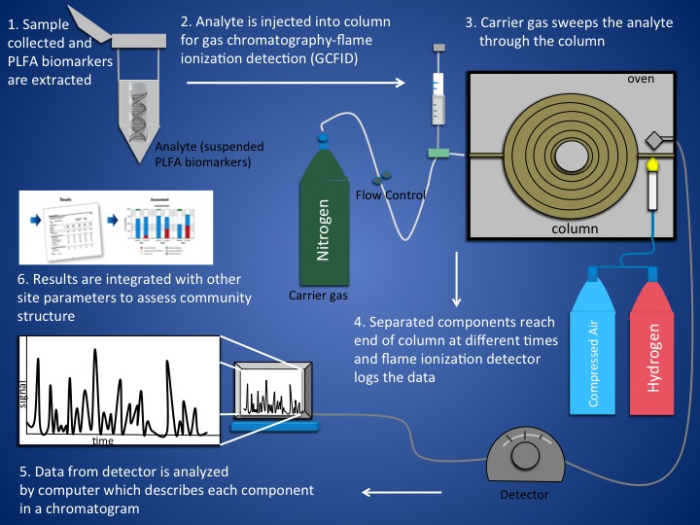
PLFA analysis provides a measure of total viable biomassIn this context, viable biomass refers to living microorganisms (capable of metabolism and/or reproduction). and a broad-based profile of the microbial community compositionDescription of the types or identities of microorganisms present in a sample. grouped into general categories. The general process is illustrated in Figure 5-1. Other than in combination with stable isotope probing (SIP), PLFAPhospholipid fatty acids derived from the two hydrocarbon tails of phospholipids. analysis is best suited for general questions such as whether a treatment increased (or decreased) total biomass or substantially altered redox conditionsDescription of the oxidation/reduction potential of the subsurface (e.g. aerobic, anaerobic, sulfate reducing, or methanogenic conditions). It should be noted that PLFA can not analyze for ArchaeaMicroorganisms that are genetically distinct from bacteria. Methanogens are an example of archaea (www.biology-online.org, accessed online, 2013). such as methanogens.
Source: Microbial Insights, Inc, 2010. Used with permission.
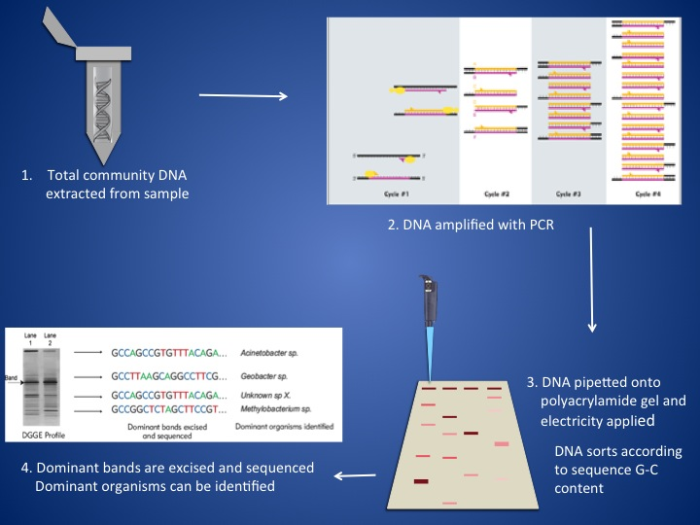
DGGE and sequence analysis provides a DNA- based profile of the microbial community and allows identification of the predominant organisms generally to the family or genus level. DGGE analysis cannot, however, quantify specific organisms or microbial functions present within a sample. The DGGE process is illustrated in Figure 5-2. DGGE profiles are used to visually display differences or shifts in microbial community composition over time or in response to treatment. Sequence analysis following DGGE is somewhat exploratory, seeking to answer the question “Who is there?” In addition, DGGE can also be used to identify and compare the presence/absence of specific organisms among samples. Most often, DGGE analysis followed by sequencing is performed when identification of the predominant organisms is required but little is known about the microbial community of the sample prior to the analysis.
Source: Microbial Insights, Inc, 2010. Used with permission.
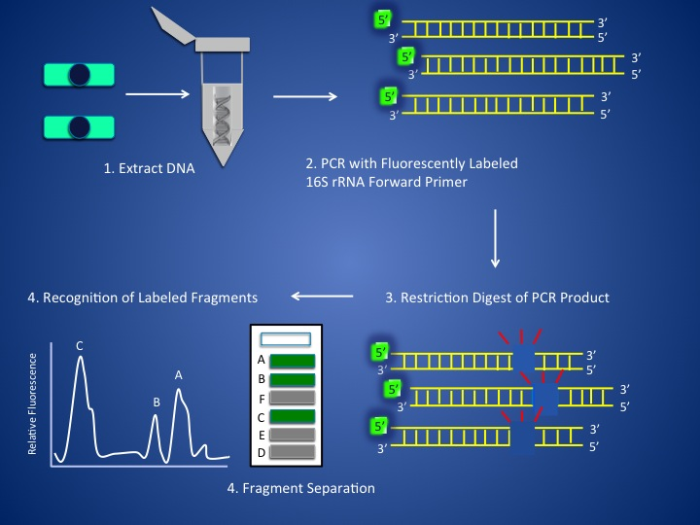
T-RFLP involves digestion of genetic material (DNA) with restriction enzymesRestriction enzymes (also called restriction endonucleases) are bacterial enzymes that recognize and cut specific DNA sequences (typically 4 to 6 base pairs long). Each restriction enzyme has a unique recognition and cleavage site sequence. that cleave DNA at specific sites. These sites differ between microorganisms, resulting in different DNA fragment lengths (and sequences), which can be used to identify some members of a microbial community and provide a fingerprint of its composition. The T-RFLP process is illustrated in Figure 5-3. As with DGGE, T-RFLP information is nonquantitative or at best semi-quantitative.
Source: Microbial Insights, Inc. 2011. Used with permission.
Microbial fingerprinting methods have been used to investigate microbial populations at many different environmental remediation sites ranging from metal contaminated sites (USEPA 2009), to retail gasoline stations (Nales 1998), to Superfund sites (USEPA 2006). Microbial fingerprinting techniques can be used with other EMDs (see Section 7 and Table 2.2). For example, PLFA analysis is used in conjunction with SIP to document that biodegradationA process by which microorganisms transform or alter (through metabolic or enzymatic action) the structure of chemicals introduced into the environment (USEPA 2011). is occurring. Although often requiring greater quantities of the isotopically labeled contaminantA contaminant that has been specially synthesized to deliberately contain specific isotopes at elevated levels above those found in either natural or commercial bulk forms of the same chemical. , the genetic fingerprinting techniques can also be used with SIP to not only demonstrate contaminant biodegradation but also to potentially identify microorganisms responsible.
Site characterization, remedy selection, and monitoring require thorough examination of available chemical, geochemical, and microbiological data. Using microbial fingerprinting techniques such as PLFA and DGGE can provide evidence of the functional groups present and the diversity of the microbial community of a site. These methods can elucidate the initial community structure of a site as well as show the changes in microbial activityRefers to when a microorganism performs a specific function (e.g., sulfate reduction, metabolism of benzene) following treatment. Examples of sites where fingerprinting methods have been successfully used are presented in Table 5-1.
|
Title |
General information |
Contaminants |
EMDs |
Project life cycle stage |
|---|---|---|---|---|
|
Fort Lupton, CO (see description below) |
Understand the role of the vadose zone in biodegradation of hydrocarbons |
BTEX |
PLFA |
Site Characterization |
|
Tallgrass Prairie Reserve, OK (see description below) |
Understand crude oil impacts on soil ecology |
Crude Oil |
PLFA |
Monitoring and Closure |
|
Microbial Fingerprinting Case Study – PCB Dechlorination, Washington DC (see description below) |
PCR-DGGE was used to evaluate changes in dechlorinating bacteria |
PCBs |
DGGE |
Remediation |
|
Microbial Fingerprinting Case Study – BTEX Degradation, WA (see description below) |
Confirm biodegradation with sulfate amendment |
BTEX (Benzene, Toluene, Xylene, Ethylbenzene) |
PLFA, qPCR |
Monitoring |
Microbial fingerprinting techniques are often employed at the site characterization stage to investigate the microbial community structure and composition, to evaluate the types of microbial processes that may be occurring, and to aid in development of a conceptual model.
This is a site at which groundwater was impacted with gas condensate hydrocarbons from a leaking underground sump used to store produced water. Long-term monitoring had demonstrated contaminant biodegradation and generation of anaerobic conditions in the saturated zone. In this case, the goal was to examine the microbial community and assess the microbial processes occurring in the vadose zone above the dissolved plume in order to evaluate the role of the unsaturated zone in natural attenuation. PLFA and DGGE analyses along with traditional chemical measurements were performed on soil cores obtained above the dissolved plume and in background areas. At increasing depths below ground surface, PLFA analysis revealed decreasing total biomass and DGGE profiles showed decreasing bacterial diversity. At specific depths in contaminated samples that corresponded to higher levels of total petroleum hydrocarbons, CO2, and methane in soil gas however, total PLFA increased (although methanogens will not be detected by this technique). This result demonstrated an increase in bacterial biomass while DGGE revealed the selection of specific members of the microbial community, suggesting a microbial community response to the increased carbon pool (gas condensates and biogenic methane) above the water table. Moreover, PLFA and DGGE results provided the following insights into that response:
Overall, the microbial fingerprinting results suggested an active, predominantly aerobic microbial community. This community was enriched in methane oxidizing bacteria, which were most likely supported by condensate hydrocarbons and biogenic methane (produced by anaerobes in the saturated zone) transported into the vadose zone by evaporation at the water table (Sublette et al. 2002).
Microbial fingerprinting techniques can provide valuable insight during the remediation phase and can be critical during the monitoring phase and ultimate site closure.
A pipeline break resulted in the release of an unknown quantity of dewatered crude oil at the Tallgrass Prairie Reserve in Oklahoma (Sublette et al. 2007). The heavily impacted portion of the area was tilled and fertilized to promote bioremediationThe treatment of environmental contamination through the use of techniques that rely on biodegradation. Bioremediation has two essential components: biostimulation and bioaugmentation.. Approximately six years after the spill and subsequent treatment, TPH levels were near detection limits and microbial fingerprinting methods were used as a component of a study to evaluate the degree of restoration of the soil ecosystem. PLFA indicated the following at this site:
This study investigated the enhanced microbial transformation of low concentration PCBs after biostimulationA remedial technique which provides the electron donor, electron acceptor, and/or nutrients to an existing subsurface microbial community to promote degradation. and bioaugmentationThe introduction of cultured microorganisms into the subsurface environment for the purpose of enhancing bioremediation of organic contaminants (USEPA 2011). Microcosms were prepared with sediment samples from the Anacostia River. The sediments were contaminated with a weathered mixture of urban and industrial sources containing PCBs, polycyclic aromatic hydrocarbons, chlorinated pesticides, and heavy metals (Reible et al. 2006; Horne Engineering Services 2003). PCR-DGGE was used as a fingerprinting technique to detect changes in the dechlorinating bacteria population, specifically DehalococcoidesDehalococcoides is a genus of organohalide-respiring bacteria (for example, bacteria that use chlorinated solvents as metabolic electron acceptors) within the phylum Chloroflexi, in the domain Bacteria, and currently represented by a single species, Dehalococcoides mccartyi (Dhc). This species is the only one known with strains that dechlorinate dichloroethenes (DCEs) and vinyl chloride (VC) to ethene and inorganic chloride. mccartyi (Dhc), in the microcosms.
Dechlorinating bacteria were detected in several of the various microcosmA sample that is regarded as a small but representative portion of something larger. In environmental studies microcosm are typically small samples of soil, sediment, or water incubated in enclosed containers under laboratory conditions. studies, augmented with alternate electron acceptors and/or directly bio-augmented with Dhc. The PCR-DGGE analysis bands were excised and sequenced to identify the microorganisms present. Identifying the microorganism that can dechlorinate low concentration PCBs has significant benefits for site remediation. If the microbial dechlorination of PCB could be implemented and monitored in the field, as observed in the microcosm studies, then low concentration PCB sites would not require the more expensive remediation methods currently used like dredging and ex situ treatment. (Krumins et al. 2009).
At a gasoline-contaminated groundwater site, bioremediation was tested using sulfate injections. EMDs, PLFA and real-time PCR for benzylsuccinate synthase (bssA), were used to monitor the conditions in the aquifer to determine if anaerobic bacteria were stimulated and if the biodegradation rates for dissolved-phase gasoline and BTEX were increased. Both groundwater samples and Bio-Trap® sampling devices were used for microbial analyses. The site chemistry and geochemistry were also monitored. The PLFA profiles indicated an increased percentage of cyclopropyl fatty acids in biofilms as a result of the sulfate injections. Cyclopropyl fatty acids are found in anaerobic bacteria and are components of Desulfobacter speciesThe lowest taxonomic rank, and the most basic unit or category of biological classification.(www.biology-online.org). The evaluation of the chemical, geo-chemical and microbial analyses was used to understand the success of the bioremediation (Sublette et al. 2006).
The application, analysis, and interpretation of microbiology-based EMD methods differ from typical soil and groundwater geochemical measurement in a number of ways. For example, microbial biomarkers cannot easily be preserved, and sample handling and processing requires special care. The analysis of microbial parameters requires specific data quality considerations for sampling plans, sample collection and handling, quality control and laboratory procedures, and these are discussed in Section 10. Included below is a brief introduction to how fingerprinting data are typically reported and some specific examples of how the data would be interpreted in answering the questions presented in Table 2-3.
For PLFA, the total biomass in the sample is presented as the total number of cells per milliliter (ml) of water or per gram (g) of solid matrix (usually soil). Community structure is presented as the percentage of the different functional groups (such as iron reducers, sulfate reducers, or fermenters). The physiological responses of ProteobacteriaA broad phylum of gram negative bacteria that is categorized into six groups, involving many genera, based on 16s rRNA differences to different environmental stresses are reported as decreased membrane permeability and slowed growth ratios. These ratios are best used in long-term monitoring projects where multiple measurements are taken over time (Hedrick 2000; MacNaughton et al. 1999; Frostegård, Tunlid, and Baath 1996; Frostgård, Tunlid, and Baath 2011; Fischer, Schauer, and Heipieper 2010).
For DGGE and T-RFLP, the identities of the dominant genera within the microbial community are presented. A DGGE report typically includes a photo of the gel (see Figure 5.2), the family or genus of the microorganisms identified, and the similarity index to gauge how well the DNA sequence recovered from the sample matched the sequence found in public databases (Muyzer, de Wall, and Uitterlinden 1993). However, since individual “bands” are excised from the gel for sequencing, typically only 3 to 10 microorganisms are identified by DGGE analysis. The number of microorganisms that can be identified by T-RFLP (Osborn 2001) can be ten times greater, thus providing more comprehensive examination of the microbial community composition.
Table 5-2 includes information that should be provided in laboratory reports of fingerprinting EMD data including common laboratory report information, recommended information about the fingerprinting methods, and desirable information about the fingerprinting method and results.
Interpretation of results depends on the specific microbial fingerprinting method, the questions being addressed, and stage in the overall project life cycle. To illustrate interpretation of PLFA, DGGE, and TRFLP results, each question posed in Table 2.3 is discussed below.
A) Are contaminant-degrading microorganisms present?
Although other EMDs (such as qPCR) should be used to detect and quantify target microorganisms, fingerprinting techniques can provide valuable insight when specific target microorganisms and biochemical pathways are unknown. In general terms, evaluation of microbial community profiles and composition should focus on comparisons between background (non-impacted) and impacted samples. For example, at a PCE contaminated site, if total PLFA bacterial biomass is substantially lower in samples from the impacted zone than in background areas, microbial growth may be inhibited and MNA strategies that rely primarily on biodegradation may not be feasible. Alternatively, biostimulation may need to be considered. In addition, certain classes of PLFA biomarkers can supplement traditional geochemical analyses to assess the dominant redox conditions (such as aerobic or anaerobic) within and outside the contaminated zone. Finally, PLFA analysis is often performed as a component of an SIP study to evaluate the feasibility and performance of MNA by conclusively determining whether biodegradation of specific a contaminant is occurring under existing site conditions.
The nucleic acidA complex biomolecule consisting of a long “backbone” of organophosphate sugars with four different types of nucleotide bases attached.-based fingerprinting methods (DGGE, T-RFLP) are used to identify the predominant microorganisms present in a sample when used in conjunction with sequencing information. Theoretically, the presence of a contaminant exerts a selective pressure on the microbial community, promoting growth of microorganisms capable of using the contaminant under the given subsurface conditions. For example, consider a site impacted by an emerging contaminant—a biodegradation pathway is not yet known and contaminant-degrading microorganisms have not been identified. As an exploratory tool, this comparison of microbial community composition in background versus impacted samples could provide an initial indication of what microorganisms may be important specific to biodegrading the emerging contaminants.
H) Are numbers of contaminant-degrading microorganisms and/or genes changing?
As mentioned previously, other EMDs should be used to detect and quantify contaminant-degrading microorganisms or functional genes when degraders are known and pathways have been identified. However, fingerprinting techniques can provide valuable insight when specific target microorganisms and biochemical pathways are unknown. Moreover, fingerprinting techniques can answer general questions relating to the viability, health, and diversity of the microbial community.
Many remediation plans include a tiered approach (a treatment train) where physical (air sparging, soil vapor extraction, or multi-phase extraction) or chemical (in situ chemical oxidation using Fenton’s reagent, permanganate, or persulfate) alternatives are employed to address contaminant mass in the source area, followed by MNA or bioremediation, to meet site closure requirements. Fingerprinting can be used to understand how the microbial community responds to the physical or chemical remediation and then recover for ongoing MNA or bioremediation. Specifically, subsurface conditions resulting from physical or chemical treatment processes can initially decrease the biomass and diversity of the microbial community composition. Fingerprinting methods can also be used to gain additional insight into the predominant terminal electron accepting processes following the physical or chemical treatment.
For a site with BTEX and petroleum hydrocarbon contamination, fingerprinting methods can reveal microbial responses during various phases of the remediation. A tiered site remediation plan at the site called for in situ chemical oxidation treatment using active persulfate to reduce contaminant mass in the source area followed by MNA or a bioremediation strategy to meet site closure requirements. The choice to use either MNA or bioremediation was made after fingerprinting was conducted again to see how the microbial community responded and recovered after the chemical oxidant completed its reaction. Initially, decreases in total PLFA (bacterial biomass) along with decreases in the ratios of specific PLFAs directly indicated an immediate adverse impact to the microbial community following the chemical oxidant addition. However, after the chemical oxidant reacted, residual sulfate from the persulfate was suspected to be present and may have served as an alternative electron acceptorA chemical compound that accepts electrons transferred to it from another compound (based on USEPA 2011). to subsequently stimulate the biodegradation of the residual petroleum through sulfate reduction. Therefore, in addition to sampling for residual sulfate in the subsurface, microbial fingerprinting techniques can also be included in the remedy performance sampling plan to provide indications whether and when sulfate reducers may become stimulated to address the remaining petroleum contaminants.
I) Is the remediation strategy affecting the numbers or types of contaminant-degrading microorganisms?
Again, microbial fingerprinting methods cannot be used to quantify specific contaminant-degrading microorganisms or functional genes involved in contaminant biodegradation. However, DGGE and T-RFLP can indicate whether or not there are shifts in the total community structure over time, which might be used to inform the relative abundance of contaminant degraders depending on the type and extent of information available (that is, if a specific restriction fragment or DGGE band has been linked to a degrader). Microbial fingerprinting techniques are best suited for general questions relating to either identifying the predominant microorganisms present in the sample or the viability, health, and diversity of the microbial community.
One example of the use of fingerprinting techniques during remediation is the evaluation of the secondary impacts of a treatment technology such as in situ chemical oxidation. PLFA analysis can be used to determine whether chemical oxidation has adversely impacted the microbial community or to monitor recovery of the microbial community following ISCO and assess the feasibility of subsequent biodegradation. While other EMDs are more appropriate for tracking known contaminant degraders, microbial fingerprinting techniques can be employed to investigate the overall impacts of a remediation strategy. For example, PLFA results showing an increase in total biomass relative to baseline levels indicate microbial growth in response to the treatment approach. Likewise, comparison of baseline DGGE to post-treatment DGGE profiles can reveal which microorganisms or types of microorganisms were enriched by the treatment approach as well as those which may no longer be dominant following the change in subsurface conditions. In other words, the comparison is used to determine the impact of the treatment approach on the overall microbial community composition.
O) Does the microbial community composition support the remediation strategy?
Monitoring specific groups of contaminant-degrading microorganisms or one particular functional geneA segment of DNA that encodes an enzyme or other protein that performs a known biochemical reaction. For example, the functional gene tceA encodes the reductive dehalogenase enzyme that initiates reductive dechlorination of TCE. Other genes can code for RNA entities which can regulate the activity of other DNA target sequences. does not always provide the complete picture needed to assess a remediation strategy. For example, although PLFA is not capable of directly measuring the effect of amendments on the specific organisms involved in biodegradation, it can be used to indirectly assess the impact by measuring overall changes in biomass, microbial composition of the site, and redox state. Thus, if an electron donorA chemical compound that donates electrons to another compound (based on USEPA 2011). was used as an amendment, an increase in the proportion of the anaerobic PLFA biomarkers using that amendment should occur, whereas if an electron acceptor such as oxygen was used, a decrease in the proportion of the same biomarkers should be noted.
Moreover, biostimulation can depend upon interactions between different microorganisms and be hindered by other microbial interactions. At a site which was impacted by a mixture chlorinated solvents undergoing biostimulation, the injected electron donor was fermented by a diverse group of microorganisms producing hydrogen, which in turn was used by many of the known dechlorinating bacteria and competing microorganisms. While qPCR would be more appropriate to track stimulation of known contaminant-degrading microorganisms (such as Dhc) and competitors (sulfate reducing bacteria), nucleic acid-based fingerprinting techniques or microarrays could be used for more comprehensive evaluation of the overall microbial community. For example, a T-RFLP profile may reveal an increase in the proportions of potential dechlorinating microorganisms (such as Chloroflexi) and supporting microbial populations involved in fermentation (Firmicutes).
P) Do contaminant-degrading microorganisms continue to be sufficiently abundant?
See Question H.
Some variability of closure requirements exists among states and programs. However, in many situations, EMD data can serve as an additional line of evidence for understanding what processes are important in reducing contaminant mass and concentrations and reaching the applicable closure levels. The evidence provided by EMD data can reveal whether biodegradation processes are occurring, have sufficiently proceeded, or are likely to continue (See Sublette et al. 2007).
W) Is contaminant degradation likely to continue?
Fingerprinting techniques do not provide direct evidence regarding degradation, but fingerprinting can provide indirect evidence that the contaminant degradation is occurring during the monitoring phase. Once it is established, continued degradation is possible as long as no substantial changes occur in subsurface geochemical conditions and or in microbial community composition thereafter. For example, consider a site which has had PCE contamination in which PLFA analysis was used to monitor viable biomass and community structure after the completion of an in situ oxidation. Changes in total PLFA (biomass), anaerobic PLFA biomarkers, or alterations in the ratios of specific PLFAs (for example relevant to sulfate reducers) could signal changes in the health and viability of the subsurface microbial community which may impact further contaminant biodegradation. Furthermore, a stable microbial population and community composition would suggest that degradation is likely to continue.
AA) Does the microbial community composition suggest that sufficient contaminant degradation has occurred?
Throughout the project life cycle, from release of the contaminants through remediation to closure, site management activities will impact the subsurface microbial community. For example, bioremediation will stimulate a relatively small number of microorganisms, and over time the diversity should increase as the contaminants are removed. Fingerprinting techniques can be useful for tracking such changes in community composition, but only if there are relevant baseline or background samples for comparison and several samples taken over time to monitor the changes over time. While a complete return to baseline conditions may not be feasible, a diverse microbial community with viable biomass levels comparable to background would provide an indication of recovery. For example, comparison of DGGE profiles from samples obtained in impacted areas after treatment with those of baseline or background samples should reveal microbial community structures of similar, but likely not identical, diversity.
Interpretation of most site monitoring data, including microbial fingerprinting, is most conclusive when based on comparisons to corresponding results for background (non-impacted, upgradient) or baseline (prior to treatment) samples. For example, PLFA results showing an increase in total biomass relative to baseline levels indicate microbial growth in response to the treatment approach. Likewise, comparison of baseline DGGE to post-treatment DGGE profiles can reveal which microorganisms or types of microorganisms were enriched by the treatment approach as well as those which may no longer be dominant following the shift in subsurface conditions. In other words, the comparison is used to determine the impact of the treatment approach on the overall microbial community composition. Other EMDs such as qPCR (if available) may be more appropriate for tracking numerical and functional changes in specific microbial populations in response to treatment. Overall, the central lesson learned in microbial fingerprinting for environmental restoration applications is that analysis of background or baseline samples is invaluable for productive interpretation of results. Additional information about fingerprinting methods is included in the fingerprinting fact sheet.
The primary difference in the results provided by each technique is in the degree of resolution or specificity. Choosing between these techniques therefore depends primarily upon the specificity of the questions that need to be addressed and the current state of knowledge regarding the microbial process in question.
Fingerprinting methods are used to provide an overall view of the microbial community, indications of microbial diversity, insight into the types of metabolic processes occurring in the sample (notably the terminal electron accepting processes, such as sulfate reduction), and some can be used to identify a subset of the microorganisms present in the sample. This information is relevant because biodegradation inherently depends upon the types and abundance of microorganisms present in the subsurface. For example, microbial fingerprinting methods can identify when adverse conditions (such as low pH), either natural or following a remedy such as chemical oxidation, result in low microbial biomass and microbial diversityMicrobial diversity can have many definitions but in this context generally refers to the number of different microbial species and their relative abundance in an environmental sample (Nannipieri et al. 2003). rendering biodegradation unlikely under existing conditions. Similarly, microbial fingerprinting methods can be used to determine if the overall microbial community has recovered or responded to remedial actions. While other EMDs are more appropriate to detect and quantify known contaminant degrading microorganisms, several microbial fingerprinting techniques can be used to identify the predominant microorganisms present in the sample.
Genetic fingerprinting methods are not quantitative, and many important microbial processes are conducted by a numerically small portion of the total population (<1%) that may not be detected by fingerprinting techniques. T-RFLP may be more sensitive than DGGE for detecting less abundant microorganisms, but it is still limited for such uses as compared to more specific methods such as PCR. Interpretation of microbial community fingerprints is somewhat subjective and less straightforward than for other EMDs and identification is limited to known microorganisms and available DNA sequences.
PLFA analysis provides a measure of total viable bacterial biomass and a broad-based profile of the microbial community composition grouped into general categories. PLFA analyses can provide information on the changes in the community without determining the exact species composition, since a change in the PLFA pattern should indicate an altered community. PLFA analysis can address general questions such as whether a treatment increased or decreased total bacterial biomass or substantially altered redox conditions.
DGGE and sequence analysis provides a DNA-based profile of the microbial community and allows identification of the predominant organisms generally to the family or genus level but cannot quantify specific organisms or microbial functions. DGGE profiles are used to visually display differences or shifts in microbial community composition over time or in response to treatment. Subsequent sequence analysis is somewhat exploratory, seeking to identify specific types of organisms. Most often, DGGE analysis is performed when identification of the predominant organisms is required but little is known about the microbial community of the sample prior to analysis. Although DGGE can be used to identify microorganisms (unlike PLFA, for example), the number of microorganisms that can be identified depends on the complexity of the microbial population. Typically, only three to ten microorganisms can be identified per sample.
While the DNA-based microbial fingerprinting methods (DGGE, T-RFLP) are used to identify microorganisms present in a sample, other EMDs provide more specific results and may be more appropriate for evaluating contaminant biodegradation. For example, qPCR provides very specific results—quantification of a specific microorganism (for example, Dhc) or genes encoding a specific function (reductive dechlorination of vinyl chloride) responsible for biodegradation of common groundwater contaminants. In these cases where site management questions focus on evaluating biodegradation of a specific contaminant or group of compounds, other EMDs such as qPCR are often more applicable.
Despite their relative ease of performance, some common DNA-based fingerprinting techniques such as T-RFLP and DGGE have biases that can oversimplify the diversity in complex microbial communities. For example, T-RFLP analyses cannot differentiate terminal fragments (and consequently microbes) that share the same restriction site. Similarly, amplified 16S rRNAA subunit of the ribosome composed of ribonucleic acid (RNA). The RNA sequence is used to classify and identify microorganisms (e.g. genus and species). gene fragments that contain more than one base difference sometimes cannot be effectively separated by the denaturing conditions used in conventional DGGE analyses.
Like many other molecular approaches, DNA-based fingerprinting methods are likely to be replaced by approaches that exploit the increasing availability of low cost, high throughput DNA sequencing methods (see Appendix D.4 ). Current DNA sequencing methods such as pyrosequencing enable the sequencing of many thousands of PCR-amplified DNA segments from an environmental sample (see Appendix D, Question 28). Subsequent analyses of the resulting DNA sequencing data enables the relative abundance of different phylotypes to be determined for the microbial community captured in the DNA sample. These analyses are often much more comprehensive than methods such as T-RFLP and DGGE, and have the added bonus of providing the identity of microbes in addition to relative abundance and diversity. The low cost of these analyses is driven by not only rapidly decreasing DNA sequencing costs, but also by the automation of much of the analysis and by simultaneously conducting multiple analyses using barcoded PCR primers.
As with other EMD methods, however, these sequencing methods can have bias or errors. For example, during pyrosequencing error can be introduced within the DNA sequences generated, which can increase the potential to overestimate microbial diversity (Kunin et al. 2010). However, better bioinformatic tools continue to emerge to deal with and even eliminate the errors during sequencing and sequence data processing. (Quince et al. 2009; see Logares et al. 2012 for a review). Other “next-generation” high throughput sequencing approaches (such as, platforms known as Illumina®, SOLiD®, Ion Torrent™, PacBio, Starlight) are also being rapidly developed in parallel to pyrosequencing, often as research tools, but are also commercially available (see Glenn 2011 for a recent review).
Further reading on fingerprinting methods is provided in Appendix F.